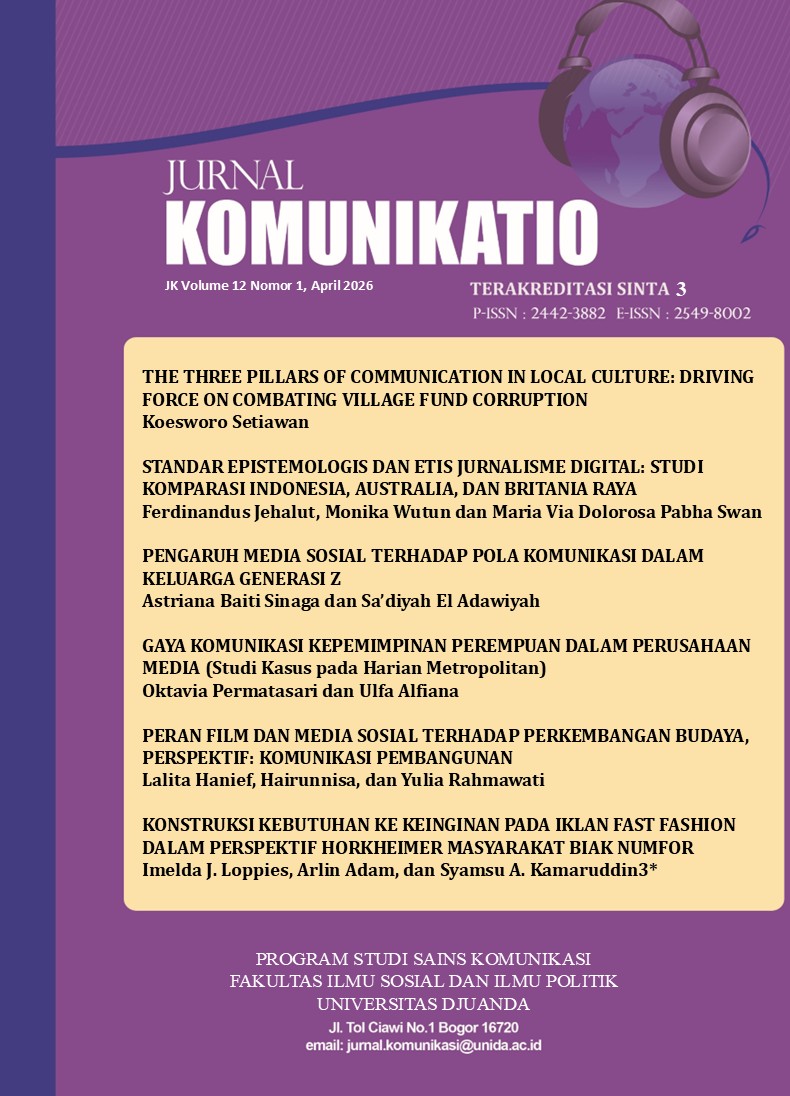
Konstruksi Kebutuhan Keinginan pada Iklan Fast Fashion Dalam Perspektif Horkheimer
DOI:
https://doi.org/10.30997/jk.v12i1.22279Keywords:
Capitalism, Critical theory, Culture industry, Digital advertising, Fast fashionAbstract
The penetration of digital technology over the past two decades has transformed patterns of public consumption, including in Biak Numfor Regency. This study aims to critically examine how exposure to fast fashion advertising on digital platforms reproduces the mechanisms of the culture industry and instrumental rationality as conceptualized by Max Horkheimer, and how these processes shape public consciousness, preferences, and consumption practices. This research employs a descriptive qualitative approach, with data collected through in-depth interviews with purposively selected informants and observations of social media usage patterns. The findings indicate that Facebook, Instagram, TikTok, and TikTok Shop serve as the primary channels for the dissemination of fast fashion advertisements. The high frequency of advertisement exposure, particularly following search or purchase activities, demonstrates the operation of algorithmic personalization as a manifestation of instrumental rationality within digital capitalism. From a Critical Theory perspective, this condition represents the transformation of the culture industry into the digital sphere, where platforms not only market products but also construct false needs and normalize rapid consumption as part of a modern lifestyle. The study further reveals that exposure to fast fashion advertising contributes to the commodification of identity and the reproduction of consumerist values, gradually shifting the community’s collective orientation toward individualistic and symbolic logic. Clothing is no longer understood merely as a functional necessity but as a means of social legitimation mediated by platform capitalism. These findings affirm the subtle operation of ideological domination through digital media and underscore the importance of strengthening critical literacy in responding to the expansion of global consumer culture.
References
Abidin, C. (2018). Internet celebrity: Understanding fame online. Emerald Publishing. https://doi.org/10.1108/9781787560792
Adom, D., Hussein, E., & Agyemang, A. (2018). Theoretical and conceptual framework: Mandatory ingredients of a quality research. International Journal of Scientific Research, 7(1). https://scholar.google.com/scholar?cluster=2787889201574363512
Arinda, S. (2021). Digital payment behavior and impulsive consumption in Indonesia. Journal of Consumer Studies, 12(3). https://journal.uin-alauddin.ac.id/index.php/jcs (contoh jurnal consumer studies Indonesia)
Baudrillard, J. (2017). The consumer society: Myths and structures. Sage. https://us.sagepub.com/en-us/nam/the-consumer-society/book234403
Chandra, V. (2020). Digital advertising and impulsive buying among young consumers. Journal of Digital Marketing Research, 8(2).
Creswell, J. W. (2014). Research Design: Qualitative, Quantitative, and Mixed Methods Approaches (4th ed.). Sage. https://scholar.google.com/scholar?q=Creswell+2014+Research+DesignHorkheimer, M., & Adorno, T. W. (2016). Dialectic of enlightenment. Stanford University Press.%0Ahttps://www.sup.org/books/title/?id=25966%0A
Davenport, Thomas H., & J. C. B. (2001). The Attention Economy: Understanding the New Currency of Business. Harvard Business School Press,.
Eslami, M., Rickman, A., Vaccaro, K., Aleyasen, A., Vuong, A., Karahalios, K., Hamilton, K., & Sandvig, C. (2017). ). ”I always assumed that I wasn’t really that close to [her]”: Reasoning about invisible algorithms in news feeds. Proceedings of the ACM CHI Conference. https://dl.acm.org/doi/10.1145/3173574.3174181Kellner, D.
Horkheimer, M., & Adorno, T. W. (n.d.). Dialectic of Enlightenment: Philosophical Fragments. Journal of Fashion Marketing, 14(1). https://www.sup.org/books/title/?id=2423Kim, S. (2020).
Kellner, D. (2017). Culture Industry Reconsidered: Horkheimer and Adorno’s Critical Theory Today. https://scholar.google.com/scholar?q=Kellner+2017+culture+industry
Kim, S. (2020). Fast fashion marketing strategies in the digital era. Journal of Fashion Marketing, 14(1).
Lestari, M. (2021). Online personal shopper (jastip) and consumer culture in Indonesia. Indonesian Journal of Social Research, 5(1). https://ijsr.or.id
Mandowen, M. (2018). Cultural identity and traditional clothing of Biak society. Papua Cultural Review, 4(2). https://ejournal-papua-review.org
Miller, D. (2016). The comfort of things. Polity Press. https://www.wiley.com/en-us/The+Comfort+of+Things-p-9780745644259
Narayan, A. (2020). Digital Logistics and Consumer Convenience in the E Commerce Era. Journal of Retail & Consumer Studies, 12(4). https://scholar.google.com/scholar?q=Narayan+2020+digital+logistics
Rahman, F. (2019). Online shopping and lifestyle transformation in Indonesia. Journal of Digital Society, 7(1). https://jds.or.id
Rook, Dennis W., & J. R. F. (n.d.). Normative Influences on Impulsive Buying Behavior.”. Journal of Consumer Research, 22(3).
Setiawan, A. (2020). Youth consumption patterns in urban Indonesia. Sociology and Culture Journal, 11(2). https://scjournal.id
Shifman, L. (2019). Memes in Digital Culture (Updated ed.). MIT Press. https://mitpress.mit.edu/9780262539470/memes-in-digital-culture/
Smith, A. (2018). Digital consumption and identity formation. Journal of Consumer Culture, 18(4). https://journals.sagepub.com/home/joc
Thompson, J. (2017). Media and modernity: A social theory of the media. Stanford University Press. https://www.sup.org/books/title/?id=25231
Tiia, A. (2024). Critical Approaches to Digital Consumerism: Algorithmic Power and Desire Formation. Journal of Digital Society, 3(1). https://scholar.google.com/scholar?q=Tiia+2024+algorithmic+power
Wanggai, Y. (2022). Global fashion and cultural change in Papua. Papua Social Studies Journal, 3(1). https://pssjournal.org
Zuboff, S. (2019). Capitalism., The age of surveillance. Profile Books. https://www.profilebooks.com/work/the-age-of-surveillance-capitalism/
Downloads
Published
How to Cite
Issue
Section
License
Copyright (c) 2026 JURNAL KOMUNIKATIO

This work is licensed under a Creative Commons Attribution-ShareAlike 4.0 International License.
Authors who publish with Jurnal Komunikatio agree to the following terms:
- Authors retain copyright and grant the journal right of first publication with the work simultaneously licensed under a Creative Commons Attribution 4.0 International License that allows others to share the work with an acknowledgement of the work's authorship and initial publication in Jurnal Komunikatio.
- Authors are able to enter into separate, additional contractual arrangements for the non-exclusive distribution of the journal's published version of the work (e.g., post it to an institutional repository or publish it in a book), with an acknowledgement of its initial publication in Jurnal Komunikatio.
- Authors are permitted and encouraged to post their work online (e.g., in institutional repositories or on their website) prior to and during the submission process, as it can lead to productive exchanges, as well as earlier and greater citation of published work