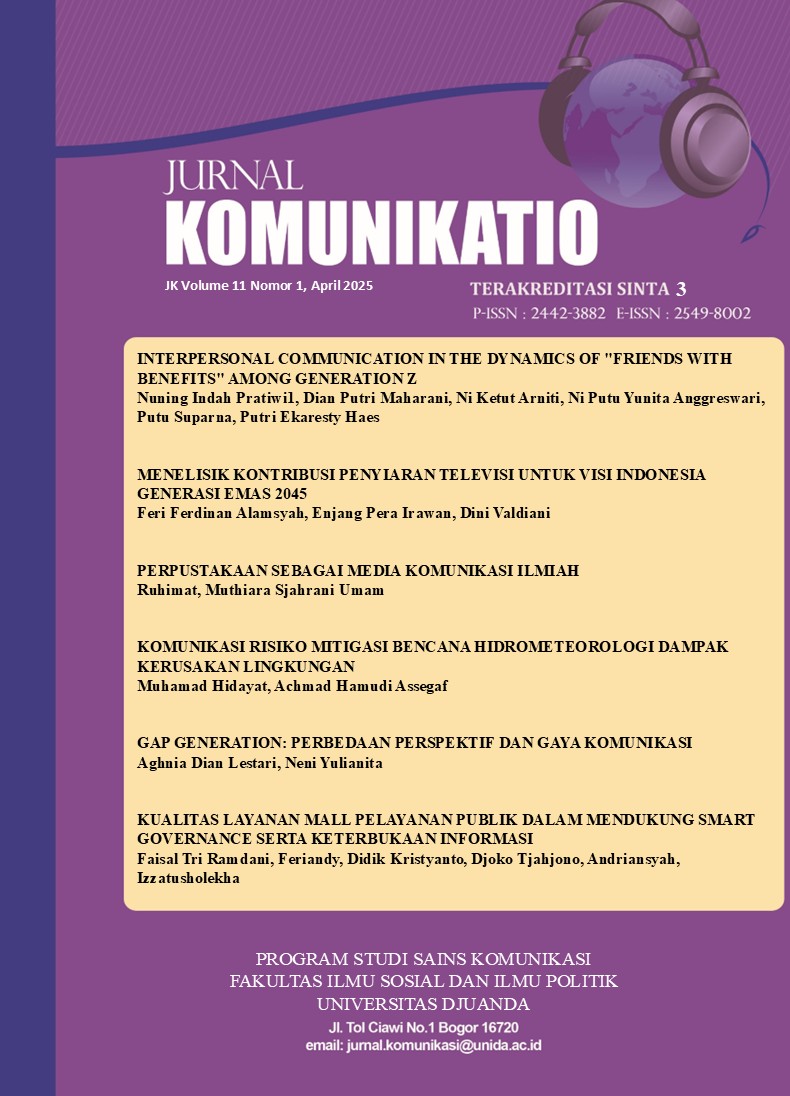
GAP Generation: Perbedaan Perspektif dan Gaya Komunikasi
DOI:
https://doi.org/10.30997/jk.v11i1.16216Keywords:
College, Gap generation, Generational conflict, Intergenerational communication, Interpersonal communicationAbstract
With the rapid advancement of technology and social change, how people from different generations interact and communicate has been transformed. Higher education is dominated by a multigenerational environment. This study aims to explore the differences in perspectives and communication patterns between generations, namely Generation X, Y (Millennials), and Z. This study uses a qualitative method with a phenomenological approach to explore the differences in perspectives and communication patterns between generations. This research uses a qualitative method with a phenomenological approach to explore how different values, experiences, and use of technology affect social and academic interactions among students. The results of this study show differences in the way of communicating in each generation, with Generation X tending to value communication more with face-to-face and formal communication, while Generation Y and Z prefer digital and informal communication. However, differences in values, experiences, and access to technology shape communication patterns in the classroom or student organization activities between generations. Gap generation is prone to conflict, such as gaps in age, appearance and lifestyle, perception, experience, behavior, and communication. It is important to build effective communication and inclusion across generations to form an understanding and perspective in creating harmonious relationships, especially in a diverse academic environment.
References
Aji, M. Q. W. (2019). Mengembangkan Kecakapan Abad 21 Mahasiswa Melalui Model Pembelajaran Inkuiri. Jurnal Teknodika, 17 (2), 70 – 84. https://doi.org/10.20961/teknodika.v17i2.35281
Anggraeni, L, Mukhlis, F. (2023). Penguatan literasi islam dan sains sebagai peningkatan wawasan generasi muda islami era society 5.0 di ikatan pemuda muhammadiyah kota batu. Jurnal Pengabdian Pada Masyarakat, 8(2), 478-489. https://doi.org/10.30653/jppm.v8i2.327
Ariyanto, Z. R., Sari, N. P., Nurhidayah, O., Hikmahwati, R., Hayat, S., & Sulistyono, Y. (2023). Kajian Fenomena Kesenjangan Generasi dalam Konteks Kehidupan Kampus menurut Perspektif Ilmu Komunikasi. Jurnal Ilmiah Ilmu Sosial, 9(2), 193-208.
Azhar, A. (2018). Komunikasi antarpribadi: suatu kajian dalam perspektif komunikasi islam. Al-Hikmah Media Dakwah Komunikasi Sosial Dan Kebudayaan, 8(1).
Bahri, A. (2018). Peran komunikasi antar pribadi pada lingkungan kerja dalam perspektif islam. Jurnal Ilmiah Sosiologi Agama (Jisa), 1(1), 128. https://doi.org/10.30829/jisa.v1i1.178
Budi, H. I. S. (2021). Minimalisir Konflik Dalam Gap Generasi Melalui Pendekatan Komunikasi Interpersonal. Jurnal Teologi Injili, 1(2), 72-87. https://doi.org/10.55626/jti.v1i2.11
Jurkiewicz, Carole L. 2000. “Generation X and the Public Employee.” Public Personnel Management 29(1):55–74.
Lyons, S. (2004). An exploration of generational values in life and at work. ProQuest Dissertations and Theses, 441-441. Retrieved from http://ezproxy.um.edu.my/docview/305203456?accountid=28930
Maimun, A. (2020). Relasi agama dan sains dalam islam (pemetaan konteks awal dan varian pemikiran sains islam). Muslim Heritage, 5(2), 261. https://doi.org/10.21154/muslimheritage.v5i2.1957
Mutawakkil, M., & Nuraedah, N. (2019). Gaya Komunikasi Dosen dalam Pembelajaran Mahasiswa. Communicatus: Jurnal Ilmu komunikasi, 3(2), 135-152. https://doi.org/10.15575/cjik.v3i2.5765
Parengkuan, E., & Tumewu, B. (2020). Generation gap (less): Seni menjalin relasi antargenerasi. Gramedia Pustaka Utama.
Putri, G. S., Hartanto, B., & Husna, N. (2019). Generation Gap; Analisa Pengaruh Perbedaan Generasi Terhadap Pola Komunikasi Organisasi di Perusahaan Consumer Goods Di Kota Surabaya. JURNAL SOSIAL Jurnal Penelitian Ilmu-Ilmu Sosial, 20(1), 36-43.
Sarkawi, S. (2024). Bentuk komunikasi dalam perspektif islam. ARJIS, 1(2), 80-91. https://doi.org/10.58824/arjis.v1i2.55
Sitepu, Widya Methasari. 2012. Penyusunan Sistem Manajemen Karir Sebagai Intervensi Kepuasan Kerja Karyawan Generasi Y Guna Meningkatkan Komitmen Organisasi pada Perusahaan INS. Tesis Fakultas Ekonomi Universitas Indonesia
Stillman, D., & Stillman, J. (2017). Generasi Z :Memahami Karakter Generasi Baru yang Akan Mengubah Dunia Kerja. Jakarta : Gramedia Pustaka Utama.
Sugiyono. 2013. Metode Penelitian dan Pengembangan. Bandung: Alfabet
Downloads
Published
How to Cite
Issue
Section
License
Copyright (c) 2025 JURNAL KOMUNIKATIO

This work is licensed under a Creative Commons Attribution-ShareAlike 4.0 International License.
Authors who publish with Jurnal Komunikatio agree to the following terms:
- Authors retain copyright and grant the journal right of first publication with the work simultaneously licensed under a Creative Commons Attribution 4.0 International License that allows others to share the work with an acknowledgement of the work's authorship and initial publication in Jurnal Komunikatio.
- Authors are able to enter into separate, additional contractual arrangements for the non-exclusive distribution of the journal's published version of the work (e.g., post it to an institutional repository or publish it in a book), with an acknowledgement of its initial publication in Jurnal Komunikatio.
- Authors are permitted and encouraged to post their work online (e.g., in institutional repositories or on their website) prior to and during the submission process, as it can lead to productive exchanges, as well as earlier and greater citation of published work