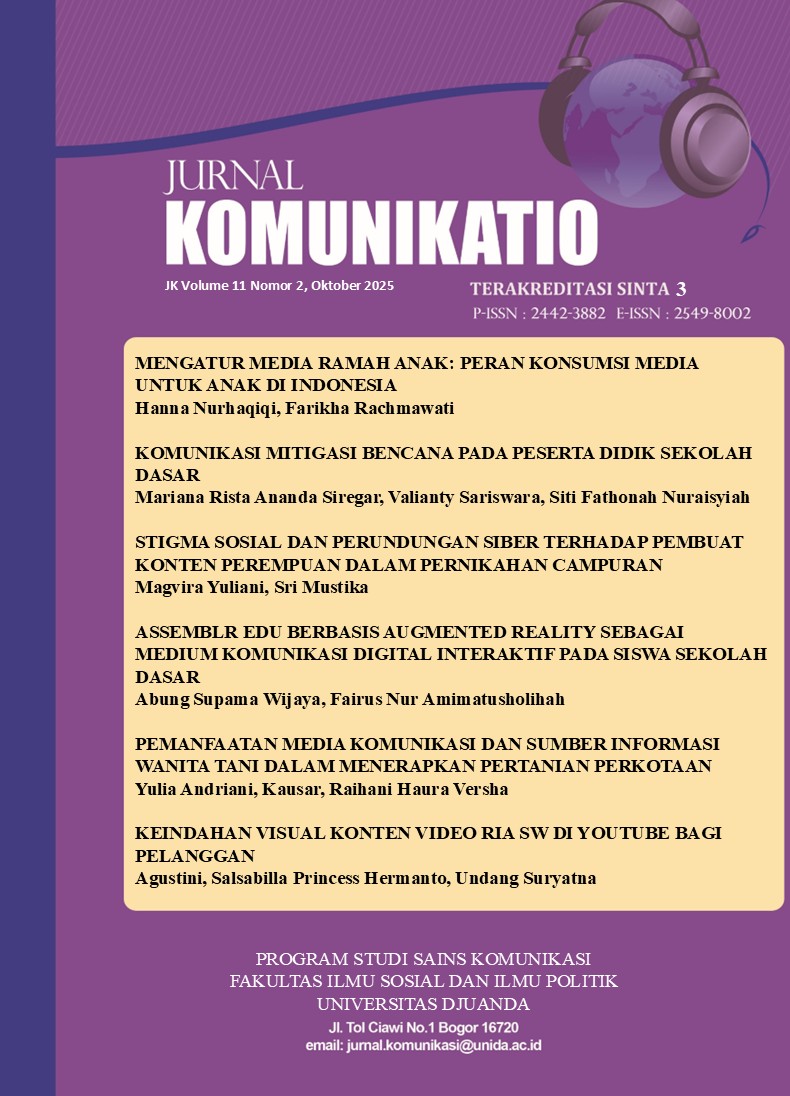
Mengatur Media Ramah Anak: Peran Konsumsi Media untuk Anak di Indonesia
DOI:
https://doi.org/10.30997/jk.v11i2.13751Keywords:
Child-friendly media, Regulation, Gadget, uses and gratificationAbstract
The media industry in Indonesia is experiencing rapid growth, along with an increasing number of audiences from various groups, including children and parents. Children, as part of the audience, have different characteristics from other age groups. Providing child-friendly media is crucial. This study aims to examine the perceptions and views of media activists and parents regarding the existence and quality of child-friendly media in Indonesia. The method used in this study was a qualitative approach with in-depth interviews with eight respondents, consisting of four media activists and four parents. Data analysis was conducted using the perspective of George Gerbner's Uses and Gratification Theory, as well as the Media Regulation theory of Sonia Livingstone and Peter Lunt. The results show that both media activists and parents believe that child-friendly media in Indonesia is currently still not optimal in meeting children's needs and interests. Available content is considered limited, less relevant to current developments, and does not fully support educational aspects or healthy entertainment for children. These findings emphasize the importance of collaboration between the media, government, and society to create stricter regulations and encourage the production of higher-quality content that is appropriate to the needs of children in today's digital era.
References
Bridle, J. (2017). Something is wrong on the internet. Https://Medium.Com/@jamesbridle/Something-Is-Wrong-on-the-Internet-C39c471271d2.
Bridle, J. (2018). The nightmare videos of childrens’ YouTube — and what’s wrong with the internet today. Https://Www.Youtube.Com/Watch?V=v9EKV2nSU8w.
Dixon, M. (2020). Media Theory for A Level. Routledge.
Franqueira, V. N. L., Annor, J. A., & Kafali, O. (2022). Age Appropriate Design: Assessment of TikTok, Twitch, and YouTube Kids. http://arxiv.org/abs/2208.02638
FTC. (2019). Google and YouTube Will Pay Record $170 Million for Alleged Violations of Children’s Privacy Law. Https://Www.Ftc.Gov/News-Events/News/Press-Releases/2019/09/Google-Youtube-Will-Pay-Record-170-Million-Alleged-Violations-Childrens-Privacy-Law.
Harrison, E., & McTavish, M. (2018). ‘i’Babies: Infants’ and toddlers’ emergent language and literacy in a digital culture of iDevices. Journal of Early Childhood Literacy, 18(2), 163–188. https://doi.org/10.1177/1468798416653175
Hidayat, D. N. (2002). Metodologi Penelitian dalam Sebuah “Multi-Paradigm Science.”
Ishikawa, A., Bollis, E., & Avila, S. (2019). Combating the Elsagate phenomenon: Deep learning architectures for disturbing cartoons. http://arxiv.org/abs/1904.08910
Jempson, M. (1999). Developing Child-Friendly Media.
Kriyantono, R. (2014). Teori Public Relations Perspektif Barat Dan Lokal Aplikasi Penelitian Dan Praktik. Kencana Prenada Media Group.
Lange, P. G. (2014). Kids on YouTube : Technical Identities and Digital Literacies.
Livingstone, S., & Lunt, P. (1994). Talk on television: Audience participation and public debate.
Miles, M., Huberman, M., & Johnny, S. (2014). Matthew Miles, Michael Hberman, Johnny Sdana - Qualitative Data Analysis_ A Methods Sourcebook-Sage. SAGE.Moleong, L. J. (2014). Metodologi Penelitian Kualitatif. Remaja Rosdakarya.
Mulyana, D., & Solatun. (2013). Metode Penelitian Komunikasi. Remaja Rosdakarya.
Neumann, M. M., & Herodotou, C. (2020). Evaluating YouTube videos for young children. Education and Information Technologies, 25(5), 4459–4475. https://doi.org/10.1007/s10639-020-10183-7
Salsabilla, A., Salsabilla Maharani, A., Darmawan, M., & Wardana, K. (2023). ELSE (Elementary School Education Journal) Youtube Kids: Solusi Mengurangi Pengaruh Negatif Pada Youtube Bagi Siswa Sekolah Dasar. 7(1).
Simanjuntak, M., Putri, M. K. N., Yuliati, L. N., Muflikhati, I., Retnaningsih, R., & Johan, I. R. (2023). Explaining Children on Youtube: The Case of Indonesian Subscriber Behavioral Intention on Kidz Youtube Channel. Jurnal Ilmu Keluarga Dan Konsumen, 16(2), 188–198.
Siregar, M. F., Laksmi, S., & Berseri, L. (2012). Memetakan Kebijakan Media di Indonesia Oleh Yanuar Nugroho Riset kerjasama antara Didukung oleh. www.fostrom.com
Swastiningrum, I. (2022). Jebakan Elsagate: Tontonan Anak-Anak yang Tidak Ramah Anak. Https://Www.Remotivi.or.Id/Headline/Konsep-Dan-Isu/777.
Wimmer, R. D., & Dominick, J. R. (2011). Mass Media Research: An Introduction.
Bridle, J. (2017). Something is wrong on the internet. https://medium.com/@jamesbridle/something-is-wrong-on-the-internet-c39c471271d2
Franqueira, V. N. L., Annor, J. A., & Kafali, O. (2022). Age Appropriate Design: Assessment of TikTok, Twitch, and YouTube Kids. arXiv. http://arxiv.org/abs/2208.02638
Livingstone, S., & Byrne, J. (2015). Challenges of parental responsibility in a global perspective: The case of children’s digital privacy. Media@LSE Working Paper. https://www.lse.ac.uk/media-and-communications/assets/documents/research/projects/parental-responsibility/Report.pdf
Neumann, M. M., & Herodotou, C. (2020). Evaluating YouTube videos for young children. Education and Information Technologies, 25(5), 4459–4475. https://doi.org/10.1007/s10639-020-10183-7
Ofcom. (2022). Children and parents: Media use and attitudes report 2022. https://www.ofcom.org.uk/research-and-data/media-literacy-research/childrens/children-and-parents-media-use-and-attitudes-report-2022
Swastiningrum, I. (2022). Jebakan Elsagate: Tontonan anak-anak yang tidak ramah anak. https://www.remotivi.or.id/headline/konsep-dan-isu/777
Downloads
Published
How to Cite
Issue
Section
License
Copyright (c) 2025 JURNAL KOMUNIKATIO

This work is licensed under a Creative Commons Attribution-ShareAlike 4.0 International License.
Authors who publish with Jurnal Komunikatio agree to the following terms:
- Authors retain copyright and grant the journal right of first publication with the work simultaneously licensed under a Creative Commons Attribution 4.0 International License that allows others to share the work with an acknowledgement of the work's authorship and initial publication in Jurnal Komunikatio.
- Authors are able to enter into separate, additional contractual arrangements for the non-exclusive distribution of the journal's published version of the work (e.g., post it to an institutional repository or publish it in a book), with an acknowledgement of its initial publication in Jurnal Komunikatio.
- Authors are permitted and encouraged to post their work online (e.g., in institutional repositories or on their website) prior to and during the submission process, as it can lead to productive exchanges, as well as earlier and greater citation of published work