Karakteristik Fisikokimia dan Organoleptik Bolu Berbasis Terigu-Garut (Maranta arundinacea) dengan Fortifikasi Bubuk Daun Kelor (Moringa oleifera)
Physicochemical and Organoleptic Characteristics of Wheat-Arrowroot (Maranta arundinacea) Based Yeast-Leavened Cake Fortified with Moringa Leaf Powder (Moringa oleifera)
DOI:
https://doi.org/10.30997/jiph.v8i1.24273Keywords:
sponge cake, functional food, moringa leaf, arrowroot flour, antioxidantAbstract
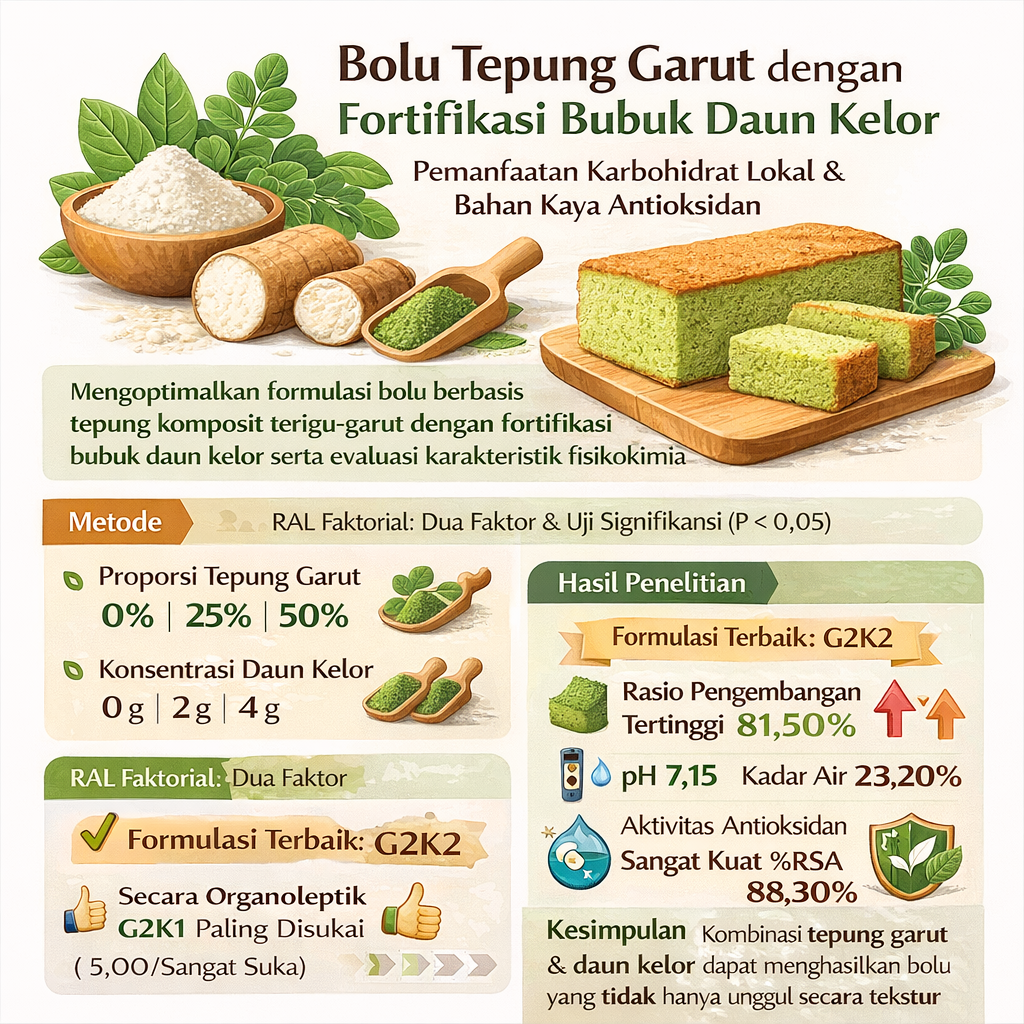
The high dependency on wheat imports and the increasing demand for functional foods have driven the utilization of local carbohydrate sources such as arrowroot flour (Maranta arundinacea) and antioxidant-rich ingredients like Moringa leaf powder (Moringa oleifera). This study aimed to optimize the formulation of a yeast-leavened cake based on wheat-arrowroot composite flour fortified with Moringa leaf powder and to evaluate its effects on physicochemical and organoleptic characteristics. The research was designed using a Factorial Completely Randomized Design (CRD) with two factors: the proportion of arrowroot flour (0%, 25%, 50%) and the concentration of Moringa leaf powder (0 g, 2 g, 4 g). The results indicated that the interaction between the two factors significantly influenced (P < 0.05) all parameters. The optimal treatment was obtained from the G2K2 formulation. This product exhibited the highest expansion ratio of 81.50%, characterized by the softest crumb structure and uniform porosity. Chemically, the G2K2 sample possessed a pH value of 7.15, a moisture content of 23.20%, and very strong antioxidant activity, with a Radical Scavenging Activity (%RSA) reaching 88.30%. Organoleptically, the G2K1 formulation was the most preferred by panelists (score 5.00/Very Liked); however, G2K2 maintained good acceptability with the added advantage of higher functional value. In conclusion, the combination of arrowroot flour and Moringa powder is capable of producing a cake that is not only superior in texture and sensory attributes but also holds potential as an antioxidant-rich functional food.
References
AOAC. (1984). Official methods of analysis. Arlington.
Dai, J., Tao, L., Shi, C., Yang, S., Li, D., Sheng, J., & Tian, Y. (2020). Fermentation improves calcium bioavailability in Moringa oleifera leaves and prevents bone loss in calcium‐deficient rats. Food science & nutrition, 8(7), 3692–3703.
Deswina, P., & Priadi, D. (2020). Development of Arrowroot (Maranta arundinacea L.) as Functional Food Based of Local Resource. IOP Conference Series: Earth and Environmental Science, 439(1), 012041. https://doi.org/10.1088/1755-1315/439/1/012041
Gama, B. D., Harmayani, E., Arsanti Lestari, L., & Huriyati, E. (2020). Comparison of chemical properties, glycemic index, and glycemic load, between arrowroot (Maranta arundinaceae) cookies containing glucomannan extract with palm sugar addition. BIO Web Conf., 28. https://doi.org/10.1051/bioconf/20202803002
Hasizah, A., Salengke, S., Djalal, M., Arifin, A. S., & Mochtar, A. A. (2023). Color change and chlorophyll degradation during fluidized bed drying of Moringa oleifera leaves. AIP Conference Proceedings, 2596(1), 040036. https://doi.org/10.1063/5.0119526
Ibrohim, M., Ardiyansyah, F., & Rudyarta, R. (2025). Strategi Indonesia dalam Menekan Ketergantungan Impor Gandum dan Kedelai (2010–2023): Perspektif Ketahanan Ekonomi Nasional. Arus Jurnal Sosial dan Humaniora, 5(2), 2410–2420.
Hapsari, D. R. ., Novidahlia, N., & Mukrimah, S. (2024). Karakteristik Fisikokimia dan Sensori Bubur Bayi Instan Berbahan Dasar Tepung Kacang Kedelai Organik (Glycine max l. merill) dan Tepung Wortel (Daucus carota) dengan Flavor Apel. Jurnal Ilmiah Pangan Halal, 6(1), 10–21.
Jeyakumar, N., Narayanasamy, B., Balasubramanian, D., & Viswanathan, K. (2020). Characterization and effect of Moringa Oleifera Lam. Antioxidant additive on the storage stability of Jatropha biodiesel. Fuel, 281, 118614. https://doi.org/10.1016/j.fuel.2020.118614
Konch, H., Gupta, R. K., & Srivastav, P. P. (2025). Novel Frontier of arrowroot starch: Extraction, modification, characterization and application in food industry. Food Biomacromolecules, 2(4), 451–470. https://doi.org/10.1002/fob2.70027
Koriyama, T., Kurosu, Y., & Hosoya, T. (2025). Enhancing Bread Quality with Steam-Treated Moringa (Moringa oleifera) Powder. Foods, 14(6), 927. https://doi.org/10.3390/foods14060927
Malki, M. K. S., Wijesinghe, J. A. A. C., Ratnayake, R. H. M. K., & Thilakarathna, G. C. (2023). Characterization of arrowroot (Maranta arundinacea) starch as a potential starch source for the food industry. Heliyon, 9(9). https://doi.org/10.1016/j.heliyon.2023.e20033
Olvera-Aguirre, G., Mendoza-Taco, M. M., Moo-Huchin, V. M., Lee-Rangel, H. A., Roque-Jiménez, J. A., Gómez-Vázquez, A., Dzib-Cauich, D. A., Vargas-Bello-Pérez, E., & Chay-Canul, A. J. (2022). Effect of Extraction Type on Bioactive Compounds and Antioxidant Activity of Moringa oleifera Lam. Leaves. Agriculture, 12(9), 1462. https://doi.org/10.3390/agriculture12091462
Raharja, K. T., Sudarmayasa, I. W., & Rahayu, A. N. (2025). Pemanfaatan Tepung Garut dengan Penambahan Tepung Kelor Ditinjau dari Sifat Sensori Biskuit. Journal of Culinary and Hospitality, 1(2).
Ramesh, B., Chauhan, R., Don, P. M. U., Joshi, R., Pansare, S., Modi, Z., Verma, A., Abdur Rahim Imthiaz, F. R., Chaudhary, P., Vashisht, P., Modak, B., Gandhi, G., & Rathnakumar, K. (2025). Moringa oleifera: A comprehensive review of its nutritional benefits, functional applications, and future potential in food science. Journal of the Science of Food and Agriculture, n/a(n/a). https://doi.org/10.1002/jsfa.70388
Nurlaela, R. S., Rifqi , M., & Kartawiria, R. F. A. (2025). Karakteristik Fisikokimia dan Sensori Hard Candy Herbal Dari Gulma Suruhan (Peperomia Pellucida L. Kunth). Jurnal Ilmiah Pangan Halal, 7(2), 152–161.
Razzak, A., Roy, K. R., Sadia, U., & Zzaman, W. (2022). Effect of Thermal Processing on Physicochemical and Antioxidant Properties of Raw and Cooked Moringa oleifera Lam. Pods. International Journal of Food Science, 2022(1), 1502857. https://doi.org/10.1155/2022/1502857
Roca, M., Chen, K., & Pérez-Gálvez, A. (2024). Chapter 8—Chlorophylls. Dalam R. Schweiggert (Ed.), Handbook on Natural Pigments in Food and Beverages (Second Edition) (hlm. 193–226). Woodhead Publishing. https://doi.org/10.1016/B978-0-323-99608-2.00017-3
Shaidah, S. N., Afriliana, A., Wibowo, Y., Soekarno, S., & Wiyono, A. E. (2024). Karakterisasi Roti Bolu Manis Berbasis Mocaf (Modified Cassava Flour) Terkomposit Serbuk Daun Kelor Sebagai Sumber Antioksidan Alami. Jurnal Teknologi Pertanian, 25(2), 175–194.
Sindhu, S. (2024). Exploring the use of gluten-free flours in innovative bakery product development: A comprehensive review. Exploring the use of gluten-free flours in innovative bakery product development: A comprehensive review, 12(2), 478–483.
Tamaroh, S., Suryani, C. L., & Astuti, D. F. A. (2023). Physical, Chemical and Preference Levels of Cendol Substituted with Purple Yam Flour (Dioscorea alata L.). JITIPARI (Jurnal Ilmiah Teknologi dan Industri Pangan UNISRI), 8(2), 93–105.
van Rooyen, J., Simsek, S., Oyeyinka, S. A., & Manley, M. (2023). Wheat starch structure–function relationship in breadmaking: A review. Comprehensive Reviews in Food Science and Food Safety, 22(3), 2292–2309. https://doi.org/10.1111/1541-4337.13147
Widanti, Y. A., Nur’aini, V., Wulandari, Y. W., & Sari, E. E. K. (2021). Gluten-Free Cake Formulation Using Mocaf and Several Types of Flour from Local Food Ingredients. IOP Conference Series: Earth and Environmental Science, 828(1), 012033. https://doi.org/10.1088/1755-1315/828/1/012033
Zeng, F., Yang, Y., Liu, Q., Yang, J., Jin, Z., & Jiao, A. (2023). Effect of fermentation methods on properties of dough and whole wheat bread. Journal of the Science of Food and Agriculture, 103(10), 4876–4886.
Downloads
Published
How to Cite
Issue
Section
License
Copyright (c) 2026 Devi Fitri Astuti, Bunga Aisyah Nugrahini, M. Handan Afrizal

This work is licensed under a Creative Commons Attribution-NonCommercial-ShareAlike 4.0 International License.