Simulasi In Silico Integrasi EGF ke Lactobacillus rhamnosus GG melalui CRISPR-Cas9 Sebagai Probiotik Terapeutik Ulkus Kronis
In Silico Simulation of EGF Integration Into Lactobacillus rhamnosus GG Via CRISPR-Cas9 For Therapeutic Probiotics For Chronic Ulcers
DOI:
https://doi.org/10.30997/jiph.v8i1.23840Keywords:
CRISPR-Cas9, Lactobacillus rhamnosus GG, EGF, In Silico simulation, chronic ulcerAbstract
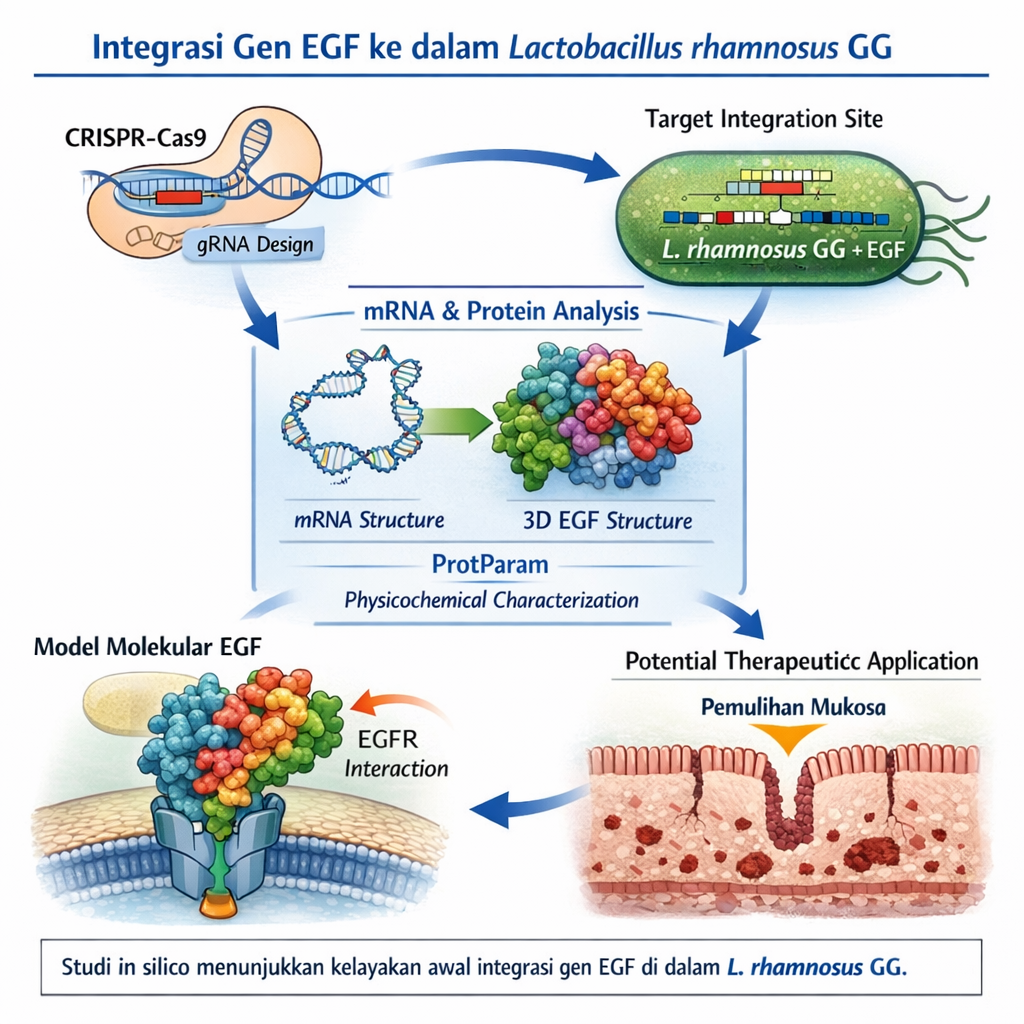
Chronic wounds are a health problem characterized by failure to heal within four weeks and the potential for physical and psychological complications. One important factor in wound healing is the availability of Epidermal Growth Factors (EGF), which is often disrupted in chronic wounds. This study aims to investigate in silico the mechanism of CRISPR-Cas9-based genetic engineering of Lactobacillus rhamnosus GG bacteria as a therapeutic probiotic that produces EGF for the healing of chronic ulcer. The research method used a bioinformatics approach that included genetic homology analysis, guide RNA design, recombinant plasmid construction, mRNA secondary structure prediction, protein physicochemical property analysis, and EGF protein tertiary structure modeling. The result showed that the EGF gene has no significant similarity with the Lactobacillus rhamnosus GG genome, the designed gRNA had good specificity and cutting efficiency, and the gene construction was potentially stable and expressed. The stimulated EGF protein showed good three-dimensional structure quality with exposed active residues. Overall, this study shows that the in silico approach has the potential to become the basis for the development of CRISPR-Cas9-based engineered probiotics as an alternative therapy for chronic wound healing.
References
Ashaolu, T. J., Greff, B., & Varga, L. (2025). Action and immunomodulatory mechanisms, formulations, and safety concerns of probiotics. Bioscience of Microbiota Food and Health, 44(1), 4-15. https://doi.org/10.12938/bmfh.2024-006
Biasni, M., Bienert, S., Waterhouse, A., Arnold, K., Studer, G., Schmidt, T., . . . Lorenza, B. (2014). SWISS-MODEL: modelling protein tertiary and quaternary structure using evolutionary information. Nucleic Acids Research, 252-258.
Boob, A., Zhu, Z., Intasian, P., Jain, M., Vassily Andrew, P., Lane, S., . . . Zhao, H. (2024). CRISPR-COPIES: an in silico platform for discovery of neutral integration sites for CRISPR/Cas-facilitated gene integration. Nucleic Acids Res.
CCHCS. (2024). Chronic Wound Management Care Guide. Chronic Wound Management Care Guide Summary.
Chang, Y., Hwang, J., Chung, T.-Y., & Shin, Y. (2018). SOX2 Activation Using CRISPR/dCas9 Promotes Wound Healing in Corneal Endothelial Cells. STEM CELLS, 1851-1862.
Chakravarty, K. and Gaur, S. (2019). Role of Probiotics in Prophylaxis of Helicobacter pylori Infection. Current Pharmaceutical Biotechnology, 20(2), 137-145. https://doi.org/10.2174/1389201020666190227203107
Dissemond, J., Chadwick, P., Weir, D., Alves, P., Isoherranen, K., Martínez, J., . . . Malone, M. (2024). M.O.I.S.T. Concept for the Local Therapy of. The International Journal of Lower, 1-9.
Duan, X., Chen, P., Xu, X., Han, M., & Li, J. (2022). Role of Gastric Microorganisms Other than Helicobacter pylori in the Development and Treatment of Gastric Diseases. Biomed Research International, 2022(1). https://doi.org/10.1155/2022/6263423
Fang, Y., Liu, L., Dempsey, P. J., Tsai, Y., Raines, E. W., Wilson, C. L., … & Polk, D. B. (2013). A Lactobacillus rhamnosus GG-derived Soluble Protein, p40, Stimulates Ligand Release from Intestinal Epithelial Cells to Transactivate Epidermal Growth Factor Receptor. Journal of Biological Chemistry, 288(42), 30742-30751. https://doi.org/10.1074/jbc.m113.492397
Febrianti, N. R., Tahir, T., & Yusuf, S. (2019). Study Literature Peran Epidermal Growth Factor dalam Proses Penyembuhan Luka. Jurnal Keperawatan Muhammadiyah, 7-13.
Freudl, R. (2018). Signal peptides for recombinant protein secretion in bacterial expression systems. Microbial Cell Factories.
Gaspar, P., Moura, G., Santos, M., & Oliveira, J. (2016). mRNA secondary structure optimization using a correlated stem–loop prediction. Nucleic Acids Research, 5490.
Gasteiger, E., Hoogland, C., Gattiker, A., Duvaud, S., Wilkins, M., Appel, R., & Bairoch, A. (2005). Protein Identification and Analysis Tools on the ExPASy Server. Humana Press.
Henn, D., Zhao, D., Sivaraj, D., Trotsyuk, A., Bonham, C., Fischer, K., & Kehl, T. (2023). Cas9-mediated knockout of Ndrg2 enhances the regenerative potential of dendritic cells for wound healing. Nat Commun., 4729.
Kolanu, N. (2024). CRISPR–Cas9 Gene Editing: Curing Genetic Diseases by Inherited Epigenetic Modifications. Global Medical Genetics, 113-122.
Jumiono, A., Mardiah, M., Amalia, L., & Puspasari, E. (2024). Identifikasi Titik Kritis Kehalalan Produk Mikrobiologi. Jurnal Ilmiah Pangan Halal, 6(1), 84–95. https://doi.org/10.30997/jiph.v6i1.10633
Konstantakos, V., Nentidis, A., Krithara, A., & Paliouras, G. (2022). CRISPR–Cas9 gRNA efficiency prediction: an overview of predictive tools and the role of deep learning. Nucleic Acids Research, 3616-3637.
Lyra, A., Saarinen, M., Putaala, H., Olli, K., Lahtinen, S. J., Ouwehand, A. C., … & Tiihonen, K. (2012). Bifidobacterium animalisssp.lactis420 Protects against Indomethacin-Induced Gastric Permeability in Rats. Gastroenterology Research and Practice, 2012, 1-9. https://doi.org/10.1155/2012/615051
Martinengo, L., Olsson, M., Bajpai, R., Soljak, M., Upton, Z., Schmidtchen, A., . . . Krister, J. (2019). Prevalence of chronic wounds in the general population: systematic review and meta-analysis of observational studies. Ann Epidemiol, 8-15.
Ogiso, H., Ishitani, R., Nureki, O., Fukai, S., Yamanaka, M., Kim, J.-H., . . . Shirouzu, M. (2002). Crystal structure of the complex of human epidermal growth factor and receptor extracellular domains. Cell, 775-787.
O’Hara, A. M. and Shanahan, F. (2007). Mechanisms of Action of Probiotics in Intestinal Diseases. The Scientific World Journal, 7, 31-46. https://doi.org/10.1100/tsw.2007.26
Perera, D., Perera, K., & Peiris, D. (2021). A Novel In Silico Benchmarked Pipeline Capable of Complete Protein Analysis: A Possible Tool for Potential Drug Discovery. Biology (Basel), 1113.
Redmond, M. C., Gethin, G., & Finn, D. P. (2025). A Review of Chronic Wounds and Their Impact on Negative Affect, Cognition, and Quality of Life. International Wound Journal.
Schilrreff, P., & Alexiev, U. (2022). Chronic Inflammation in Non-Healing Skin Wounds and Promising Natural Bioactive Compounds Treatment. Int. J. Mol. Sci., 4928.
Ugbaja, S., Mushebenge, A.-A., Kumalo, H., Ngcobo, M., & Galeni, N. (2025). Potential Benefits of In Silico Methods: A Promising Alternative in Natural Compound’s Drug Discovery and Repurposing for HBV Therapy. Pharmaceuticals.
Yin, Z., Wang, Y., Fang, X., Liu, C., Xiaoyang, G., Liu, S., . . . Li, K. (2024). Lactobacillus rhamnosus GG and Bifidobacterium animalis subsp. lactis BB-12 promote infected wound healing via regulation of the wound microenvironment. Microb Biotechnol.
Youssef, H., Elsenosi, Y., Mahfouz, M., & Hussein, S. (2020). Novel role of probiotics in improving cell proliferation and regulating proinflammatory cytokine-mediated oxidative damage of ethanol-induced gastric mucosal injury in rats. Benha Veterinary Medical Journal, 38(1), 9-16. https://doi.org/10.21608/bvmj.2020.21378.1146
Zhu, D., Liu, F., Xu, H., Bai, Y., Zhang, X., Saris, P., & Qiao, M. (2015). Isolation of strong constitutive promoters from Lactococcus lactis subsp. lactis N8. FEMS Microbiology Letters.
Downloads
Published
How to Cite
Issue
Section
License
Copyright (c) 2026 Arini Rizakiya, Alifah Rahma Mutiasari, Medina Fiamanella, Mutimmah Mutimmah, Afryansyah Afryansyah, Aji Jumiono, Erna Puspasari

This work is licensed under a Creative Commons Attribution-NonCommercial-ShareAlike 4.0 International License.