Formulasi dan Karakterisasi Tepung Komposit Berbahan Lokal Kaya Gizi untuk Diversifikasi Pangan dan Pencegahan Stunting
The Formulation and Characterization of Nutrient-Dense Composite Flour from Local Ingredients to Support Food Diversification and Stunting Prevention
DOI:
https://doi.org/10.30997/jiph.v7i3.21764Keywords:
Carrot, Composite flour, Soybean, Stunting, White sweet potatoAbstract
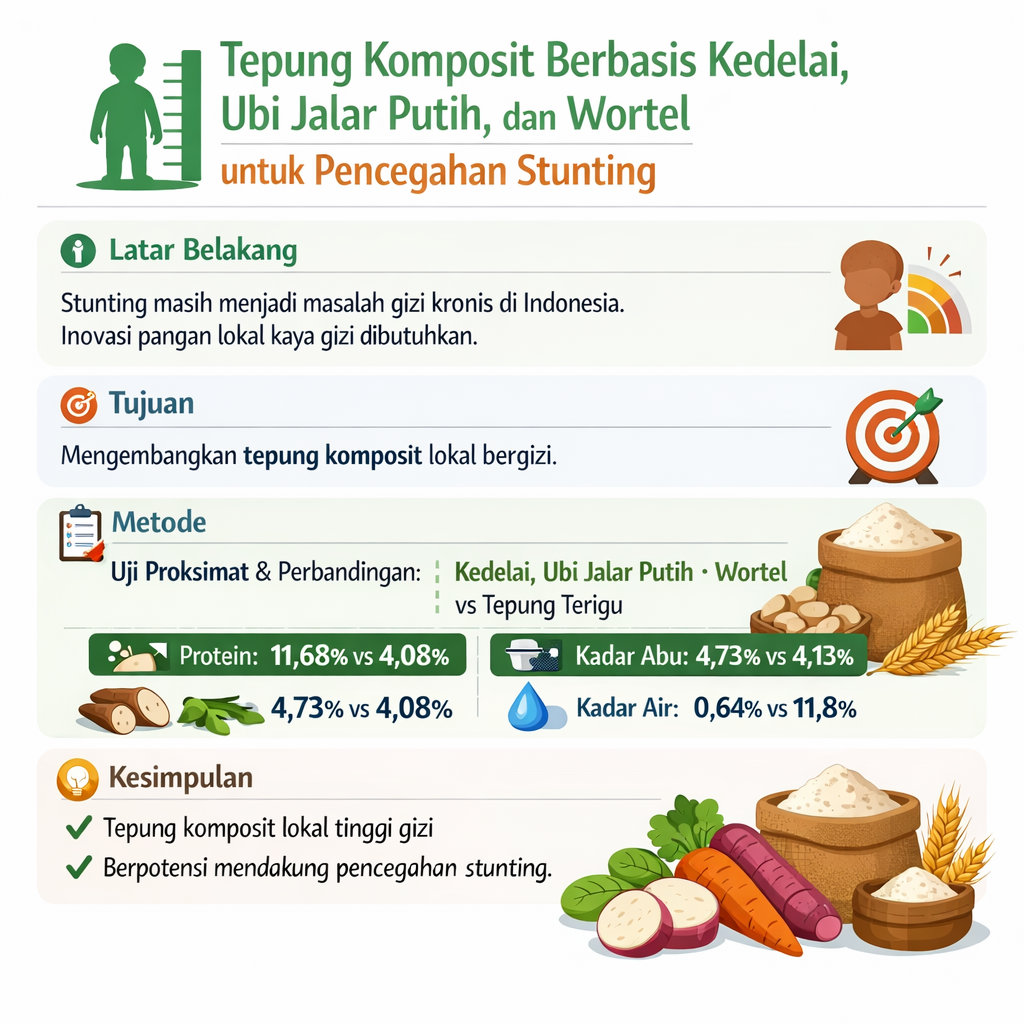
Stunting remains a major chronic nutritional problem in Indonesia, affecting growth, cognitive development, and long-term productivity. One of the preventive efforts is the innovation of nutrient-dense local food products. This study aimed to develop composite flour based on soybean (Glycine max L.), white sweet potato (Ipomoea batatas L.), and carrot (Daucus carota subsp. sativus) as an alternative food ingredient to support food diversification and stunting prevention. A true experimental design with five replications was used, including the analysis of protein, ash, and moisture contents, as well as physical observations compared with wheat flour as a control. The results showed that the composite flour had higher protein content (11.68 ± 0.23 vs. 4.08 ± 0.11), higher ash content (4.73 ± 0.11 vs. 4.13 ± 0.46), and lower moisture content (0.64 ± 0.02 vs. 11.8 ± 0.41) than wheat flour (p < 0.001). Physically, the composite flour appeared cream-yellow due to β-carotene pigments from carrots, with a normal odor and powdery texture that met the Indonesian National Standard (SNI 3751:2009). This composite flour shows potential as a nutrient-dense, locally sourced food ingredient that supports food diversification, accelerates stunting reduction, and contributes to the development of high-quality, competitive halal food products.
References
Akomolafe, S. F. (2025). Nutritional composition of three varieties of sweet potato (Ipomea batatas L.) based diet commonly consumed in Nigeria: A comparative study. Food Chemistry Advances, 8, 101067.
Awol, S. M., Kuyu, C. G., & Bereka, T. Y. (2024). Physicochemical stability, microbial growth, and sensory quality of refined wheat (or teff) flour as affected by packaging materials during storage. Journal of Stored Products Research, 105, Article 102217.
Aminullah, A., Ramadhan, A. M., & Fitrilia, T. (2024). Profil Cooking Loss dan Tekstur Mi Basah Ekstrusi Campuran Mocaf dan Tepung Talas yang Ditambah Kuning Telur. Jurnal Ilmiah Pangan Halal, 6(2), 125–133.
Badan Kebijakan Pembangunan Kesehatan. (2022). Buku saku hasil studi status gizi Indonesia (SSGI) tahun 2022. Kementerian Kesehatan Republik Indonesia.
Beal, T., Tumilowicz, A., Sutrisna, A., Izwardy, D., & Neufeld, L. M. (2018). A review of child stunting determinants in Indonesia. Maternal & Child Nutrition, 14(4), e12617. https://doi.org/10.1111/mcn.12617
Begum, R., Chowdhury, M. A. F., Hasan, M. R., Rahman, M. F., Rahman, M. H., & Alim, M. A. (2023). Efficacy of freeze-dried carrot pomace powder in improving the quality of wheat bread. Food Research, 7(6), 11–22. https://doi.org/10.26656/fr.2017.7(6).102
Berthold, A., Guion, S., & Siegrist, M. (2024). The influence of material and color of food packaging on consumers’ perception and consumption willingness. Food and Humanity, 2, 100265. https://doi.org/10.1016/j.foohum.2024.100265
Black, R. E., Victora, C. G., Walker, S. P., Bhutta, Z. A., Christian, P., de Onis, M., Ezzati, M., Grantham-McGregor, S., Katz, J., Martorell, R., Uauy, R., & Maternal and Child Nutrition Study Group. (2013). Maternal and child undernutrition and overweight in low-income and middle-income countries. The Lancet, 382(9890), 427–451. https://doi.org/10.1016/S0140-6736(13)60937-X
Chagwena, D. T., Chopera, P., Mushonga, N. G. T., Nyanga, L. K., Nyagura, S., & Matangi, E. (2020). High prevalence of suboptimal child‐feeding practices and child morbidity among families from low socio‐economic urban areas in Harare. Journal of Health Science, 8(3), 75–82.
Chandrasekara, A., & Kumar, T. J. (2016). Roots and tuber crops as functional foods: A review on phytochemical constituents and their potential health benefits. International Journal of Food Science, 2016, 3631647. https://doi.org/10.1155/2016/3631647
Dewey, K. G., & Begum, K. (2011). Long‐term consequences of stunting in early life. Maternal & Child Nutrition, 7(Suppl 3), 5–18. https://doi.org/10.1111/j.1740-8709.2011.00349.x
Endrinikapoulos, A., Afifah, D. N., Mexitalia, M., Andoyo, R., Hatimah, I., & Nuryanto, N. (2023). Study of the importance of protein needs for catch-up growth in Indonesian stunted children: A narrative review. SAGE Open Medicine, 11, 20503121231165562. https://doi.org/10.1177/20503121231165562
Harris, G. K., & Marshall, M. R. (2017). Ash analysis. In S. S. Nielsen (Ed.), Food Analysis (pp. 287–297). Springer. https://doi.org/10.1007/978-3-319-45776-5_16
Hapsari, D. R. ., Novidahlia, N., & Mukrimah, S. (2024). Karakteristik Fisikokimia dan Sensori Bubur Bayi Instan Berbahan Dasar Tepung Kacang Kedelai Organik (Glycine max l. merill) dan Tepung Wortel (Daucus carota) dengan Flavor Apel. Jurnal Ilmiah Pangan Halal, 6(1), 10–21.
Imani, A. N., Hutami, R. ., & Pertiwi, S. R. R. (2022). Karakteristik Sensori Dan Kimia Kue Kering Dari Tepung Campolay Dan Mocaf. Jurnal Ilmiah Pangan Halal, 4(1), 1–8.
Izzati, U. I., Andoyo, R., Lani, M. N., & Fetriyuna, F. (2025). Impact of soy protein-based ready-to-use foods (RUFs) as complementary feeding on growth deficits in children under five in low and middle-income countries: A review. Journal of Sustainability Science and Management, 20(5), 1068–1089. https://doi.org/10.46754/jssm.2025.05.011
Kudełka, W., Kowalska, M., & Popis, M. (2021). Quality of soybean products in terms of essential amino acids composition. Molecules, 26(16), 5071. https://doi.org/10.3390/molecules26165071
Kundarwati, R. A., Dewi, A. P., Abdullah, & Wati, D. A. (2022). Hubungan asupan protein, vitamin A, zink, dan Fe dengan kejadian stunting usia 1–3 tahun. Jurnal Gizi, 11(1), 9–15.
Lestari, T. A., Fitrilia, T. ., Rohmayanti, T., & Hastuti, A. . (2023). Analisis Kadar Kalsium dan Serat Pangan Bubur Instan Lansia Berbasis Kacang-Kacangan. Jurnal Ilmiah Pangan Halal, 5(1), 1–5.
Ma, C., Zhang, Y., Yue, R., Zhang, W., Sun, J., Ma, Z., Niu, F., Zhu, H., & Liu, Y. (2022). Establishment of a quality evaluation system of sweet potato starch using multivariate statistics. Frontiers in Nutrition, 9, 1025061. https://doi.org/10.3389/fnut.2022.1025061
Metwally, A. M., El-Sonbaty, M. W., El Etreby, L. A., El-Din, E. M. S., Hamid, N. A., Hussien, H. A., Hassanin, A., & Monir, Z. M. (2020). Stunting and its determinants among governmental primary school children in Egypt: A school-based cross-sectional study. Macedonian Journal of Medical Sciences, 8(B), 650–657. https://doi.org/10.3889/oamjms.2020.4757
Permatasari, I. ., Tiana, T. F., & Nurhalimah, S. . (2024). Karakteristik Kimia dan Sensori Bakso Analog Berbahan Dasar Jamur Tiram dengan Penambahan Tepung Kacang Bogor. Jurnal Ilmiah Pangan Halal, 6(1), 39–50.
Prendergast, A. J., & Humphrey, J. H. (2014). The stunting syndrome in developing countries. Paediatrics and International Child Health, 34(4), 250–265. https://doi.org/10.1179/2046905514Y.0000000158
Qin, Y., Naumovski, N., Ranadheera, C. S., & D'Cunha, N. M. (2022). Nutrition-related health outcomes of sweet potato (Ipomoea batatas) consumption: A systematic review. Food Bioscience, 50(B), 102208. https://doi.org/10.1016/j.fbio.2022.102208
Razzaque, M. S., & Wimalawansa, S. J. (2025). Minerals and human health: From deficiency to toxicity. Nutrients, 17(3), 454. https://doi.org/10.3390/nu17030454
Sholikhah, A., & Dewi, R. K. (2022). Peranan protein hewani dalam mencegah stunting pada anak balita. Jurnal Riset Sains dan Teknologi, 6(1), 95. https://doi.org/10.30595/jrst.v6i1.12012
Siahaan, M. F., Rahmatika, A., & Nadhiroh, S. R. (2023). Literature review: Food supplement intervention to increase Z-score height for age in stunting children [Tinjauan literatur: Intervensi suplemen makanan untuk meningkatkan Z-Skor PB/U pada balita stunting]. Amerta Nutrition, 7(1), 154–160. https://doi.org/10.20473/amnt.v7i1.2023.154-160
United Nations Children’s Fund, World Health Organization, & International Bank for Reconstruction and Development/The World Bank. (2023). Levels and trends in child malnutrition: UNICEF/WHO/World Bank Group joint child malnutrition estimates: Key findings of the 2023 edition. UNICEF & WHO.
Verawati, B., Yanto, N., & Afrinis, N. (2021). Hubungan asupan protein dan ketahanan pangan dengan kejadian stunting pada balita di masa pandemi COVID-19. Jurnal Kesehatan Masyarakat, 5(1), 415–423. https://doi.org/10.31004/prepotif.v5i1.1586
World Health Organization. (2006). The WHO child growth standards. http://www.who.int/childgrowth/standards/en/
Yan, Y. W., Simon, S. E., & Jayakumar, F. A. (2017, March 27). Isolation of β-Carotenoids for yellow pigment as food colorant with antioxidant compound from Cucurbita moschata flower. Research & Reviews: Journal of Food and Dairy Technology, 5(1).
Downloads
Published
How to Cite
Issue
Section
License
Copyright (c) 2025 Alfan Ridha, Titik Dwi Noviati, Mohammad Zainul Ma’arif, Nandine Hanifa Fatihah

This work is licensed under a Creative Commons Attribution-NonCommercial-ShareAlike 4.0 International License.