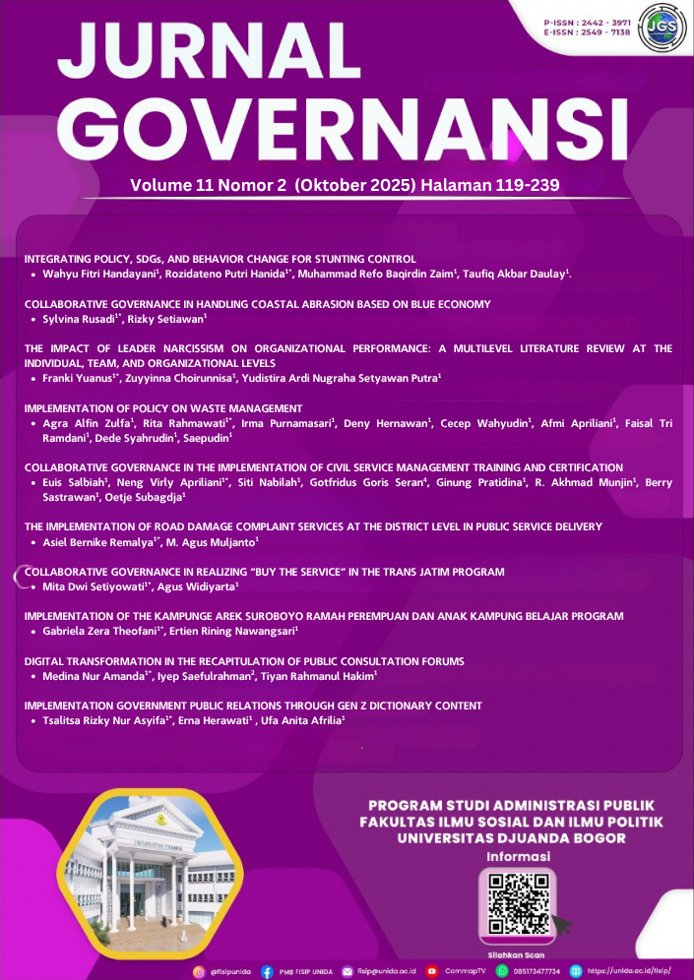
COLLABORATIVE GOVERNANCE IN HANDLING COASTAL ABRASION BASED ON BLUE ECONOMY
DOI:
https://doi.org/10.30997/jgs.v11i2.18671Keywords:
Abrasion, Blue Economy, Collaborative Governance, Coastal Abrasion, GovernmentAbstract
Indonesia is a country that has thousands of islands stretching from west to east. This causes the wealth of marine resources owned by the State of Indonesia. Unfortunately, many islands in Indonesia have experienced environmental damage due to abrasion. Abrasion has a destructive impact on the coastal environment where people live. The impacts felt are not only from an ecological perspective but also impact the economy and socio-culture of the surrounding community. This study aims to analyze and describe the implementation of collaborative governance based on the dynamics of collaboration, collaborative actions, and the impact of adaptation on the collaboration process in handling coastal abrasion on Bengkalis Island. The method used in this study is a qualitative method with a descriptive type, meaning that the research conducted describes the entirety of the phenomena found and involves several people as informants. The data sources used in this method are observation, interviews, and research documentation. This study found that collaborative governance in handling abrasion still has various dynamics between collaborators, which makes the handling process slow.
References
Ansell, C., & Gash, A. (2008). Collaborative governance in theory and practice. Journal of Public Administration Research and Theory, 18(4), 543–571.
Asmal, I., Syarif, E., Amin, S., Yahya Siradjuddin, M., Asmal, S., Rivai, F., & Latief, R. (2024). Human external and internal activities in the destruction of the north galesong coastal area. Journal of Coastal Conservation, 28(1), 1–18.
Barbesgaard, M. (2018). Blue growth: savior or ocean grabbing? The Journal of Peasant Studies, 45(1), 130–149.
Bennett, N. J., & Satterfield, T. (2018). Environmental governance: A practical framework to guide design, evaluation, and analysis. Conservation Letters, 11(6), 1–13. https://doi.org/10.1111/conl.12600
Benzaken, D., Adam, J. P., Virdin, J., & Voyer, M. (2024). From concept to practice: Financing sustainable blue economy in lessons learnt from the Seychelles experience. Marine Policy, 163, 106072.
Boyer, E. J., Van Slyke, D. M., & Rogers, J. D. (2016). An empirical examination of public involvement in public-private partnerships: Qualifying the benefits of public involvement in PPPs. Journal of Public Administration Research and Theory, 26(1), 45–61.
Cheng, Y. (2019). Exploring the role of nonprofits in public service provision: Moving from coproduction to cogovernance. Public Administration Review, 79(2), 203–214.
Croft, F., Breakey, H., Voyer, M., Cisneros-Montemayor, A., Issifu, I., Solitei, M., Moyle, C., Campbell, B., Barclay, K., & Benzaken, D. (2024). Rethinking blue economy governance–A blue economy equity model as an approach to operationalise equity. Environmental Science & Policy, 155, 103710.
Ehlers, P. (2016). Blue growth and ocean governance—how to balance the use and the protection of the seas. WMU Journal of Maritime Affairs, 15, 187–203.
Emerson, K., Nabatchi, T., & Balogh, S. (2012). An integrative framework for collaborative governance. Journal of Public Administration Research and Theory, 22(1), 1–29.
fitriani, geovani meiwanda. (2021). Bencana abrasi di kecamatan rangsang pesisir kabupaten kepulauan meranti. Journal of Publik Administration and Local Governance, 5(1), 1–14. https://doi.org/10.31002/jpalg.v5i1.3848
Foley, P., & Mather, C. (2019). Ocean grabbing, terraqueous territoriality and social development. Territory, Politics, Governance, 7(3), 297–315.
Indarsih, R., & Masruri, M. S. (2019). Mangrove conservation as an abrasion strategy risk reduction based on ecosystems in the coastal area of the Rembang Regency. IOP Conference Series: Earth and Environmental Science, 271(1), 12021.
Jentoft, S., Chuenpagdee, R., Said, A. B., & Isaacs, M. (2022). Blue justice: small-scale fisheries in a sustainable ocean economy (Vol. 26). Springer.
Keen, M. R., Schwarz, A.-M., & Wini-Simeon, L. (2018). Towards defining the Blue Economy: Practical lessons from pacific ocean governance. Marine Policy, 88, 333–341.
Knol-Kauffman, M., Nielsen, K. N., Sander, G., & Arbo, P. (2023). Sustainability conflicts in the blue economy: planning for offshore aquaculture and offshore wind energy development in Norway. Maritime Studies, 22(4), 47.
Knott, C., & Neis, B. (2017). Privatization, financialization and ocean grabbing in New Brunswick herring fisheries and salmon aquaculture. Marine Policy, 80, 10–18.
Kurnia, D., & Nugroho, D. (2018). The Effectiveness of Hybrid Structure in Overcoming Coastal Abration in Trimulyo, Genuk Sub District Semarang City. E3S Web of Conferences, 31, 8011.
Maiolini, R., Versari, P., Rullani, F., & Seitanidi, M. M. (2023). The role of community participation in cross-sector social partnerships. Nonprofit and Voluntary Sector Quarterly, 52(5), 1386–1412.
Mosley, J. E., & Wong, J. (2021). Decision-making in collaborative governance networks: Pathways to input and throughput legitimacy. Journal of Public Administration Research and Theory, 31(2), 328–345.
Mutmainah, H. (2022). Coastal Vulnerability at West Pasaman Regency. IOP Conference Series: Earth and Environmental Science, 1105(1), 12021.
Owusu, V., Lawer, E. T., Adjei, M., & Ogbe, M. (2023). Impact of offshore petroleum extraction and “ocean grabbing” on small-scale fisheries and coastal livelihoods in Ghana. Maritime Studies, 22(2), 17.
Prawiradisastra, S. (2003). Permasalahan Abrasi Di Wilayah Pesisir Kab Indramayu. In Alami (Vol. 8, Issue 2, p. 42).
Purbani, D., Salim, H. L., Kusuma, L. P. A. C. S., Tussadiah, A. T., & Subandriyo, J. S. (2019). Mengukur Ancaman Gelombang Ekstrim Dan Abrasi Pada Penggunaan Lahan Di Pesisir Kepulauan Karimunjawa (Studi Kasus: Pulau Kemujan, Pulau Karimunjawa, Pulau Menjangan Besar dan Pulau Menjangan Kecil). Jurnal Kelautan Nasional, 14(1), 33–46. https://doi.org/10.15578/jkn.v14i1.7207
Seva, T. A., Purwanto, W., & Latuconsina, A. R. (2022). Ecosystem conservation of Mangrove Education Center (MEC) in handling abration disaster at Pangkalan Jambi village based on stakeholder engagement perspective. IOP Conference Series: Earth and Environmental Science, 986(1), 12019.
Silver, J. J., Gray, N. J., Campbell, L. M., Fairbanks, L. W., & Gruby, R. L. (2015). Blue economy and competing discourses in international oceans governance. The Journal of Environment & Development, 24(2), 135–160.
Sumaila, U. R., Walsh, M., Hoareau, K., Cox, A., Teh, L., Abdallah, P., Akpalu, W., Anna, Z., Benzaken, D., & Crona, B. (2021). Financing a sustainable ocean economy. Nature Communications, 12(1), 1–11.
Voyer, M., Benzaken, D., & Rambourg, C. (2022). Institutionalizing the Blue Economy: an examination of variations and consistencies among Commonwealth countries. Philosophical Transactions of the Royal Society B, 377(1854), 20210125.
Wabnitz, C. C. C., & Blasiak, R. (2019). The rapidly changing world of ocean finance. Marine Policy, 107, 103526.
Winder, G. M., & Le Heron, R. (2017). Assembling a Blue Economy moment? Geographic engagement with globalizing biological-economic relations in multi-use marine environments. Dialogues in Human Geography, 7(1), 3–26.
Downloads
Published
How to Cite
Issue
Section
License
Copyright (c) 2025 Sylvina Rusadi, Rizky Setiawan

This work is licensed under a Creative Commons Attribution-ShareAlike 4.0 International License.
Authors who publish with Jurnal Governansi agree to the following terms:
- Authors retain copyright and grant the journal right of first publication with the work simultaneously licensed under a Creative Commons Attribution 4.0 International License that allows others to share the work with an acknowledgement of the work's authorship and initial publication in Jurnal Governansi.
- Authors are able to enter into separate, additional contractual arrangements for the non-exclusive distribution of the journal's published version of the work (e.g., post it to an institutional repository or publish it in a book), with an acknowledgement of its initial publication in Jurnal Governansi.
- Authors are permitted and encouraged to post their work online (e.g., in institutional repositories or on their website) prior to and during the submission process, as it can lead to productive exchanges, as well as earlier and greater citation of published work.