Partisipasi Masyarakat dalam Penerapan Smart Village
DOI:
https://doi.org/10.30997/jgs.v11i1.18499Kata Kunci:
Community Participation, Smart Village, Smart Governance, Sustainable DevelopmentAbstrak
Perkembangan teknologi digital telah memberikan peluang besar dalam meningkatkan tata Kelola desa melalui konsep smart village. Smart village merupakan pendekatan memanfaatkan teknologi informasi untuk mendukung Pembangunan berkelanjutan di pedesaan. Keberhasilan program ini tidak hanya ditentukan oleh infrastruktur teknologi, tetapi juga oleh partisipasi masyarakat dalam perencanaan, pelaksanaan dan evaluasi program. Namun partisipasi masyarakat dalam implementasinya masih rendah. Beberapa kendala utama meliputi kurangnya pemahaman masyarakat tentang teknologi, minimnya akses informasi, serta kesibukan dan keterbatasan waktu. Penelitian ini bertujuan untuk menganalisis tingkat partisipasi masyarakat dalam penerapan smart village serta factor-faktor yang mempengaruhi partisipasi masyarakat. Penelitian ini menggunakan metode deskriptif analisis dengan voluntary sampling. Hasil penelitian menunjukan bahwa partispasi masyarakat dalam penerapan smart village belum dilaksanakan secara optimal, hal ini dibuktikan dengan rendahnya nilai beberapa indicator yaitu partispasi masyarakat dalam rapat kebijakan local, realisasi partisipasi sosial dan partisipasi evaluasi. Dengan demikian untuk mendukung penerapan smart village di Desa Bumbung Sembalun perlu strategi untuk mengatasi hambatan partisipasi, termasuk peningkatan aksesibilitas, insentif, dan pendekatan berbasis komunitas
Referensi
A. K. M. Bahalul Haque, Bharat Bhushan, Gaurav Dhiman. 2021. “Conceptualizing Smart City Applications: Requirements, Architecture, Security Issues, and Emerging Trends.” Wiley. doi:https://doi.org/10.1111/exsy.1275.
Andrea Caragliu, Chiara Del Bo & Peter Nijkamp. 2011. “Smart Cities in Europe.” Journal of Urban Technology 18(2): 65–82. doi:https://doi.org/10.1080/10630732.2011.601117.
Baron, Marcin. 2012. “DO WE NEED SMART CITIES FOR RESILIENCE.” Journal of Economics & management 10.
Bupati, Peraturan. 2022. Peraturan Bupati Lombok Timur Nomor 46 Tahun 2022 Tentang Kota Cerdas (Smart City) Kabupaten Lombok Timur.
Cohen, J. M., & Uphoff, N. T. 1977. “Rural Development Participation: Concepts and Measures for Project Design, Implementation and Evaluation.” Cornell University.
Creswell, J. W. 2014. Research Design: Qualitative, Quantitative, and Mixed Methods Approaches. SAGE Publications.
Etikan, I., Musa, S. A., & Alkassim, R. S. 2016. “Comparison of Convenience Sampling and Purposive Sampling.” American Journal of Theoretical and Applied Statistics 5(1): 1–4. https://doi.org/10.11648/j.ajtas.20160501.11.
Fan S, Peng S, Liu X. 2021. “Can Smart City Policy Facilitate the Low-Carbon Economy in China? A Quasi-Natural Experiment Based on Pilot City.” Complexity: 1–15. doi:10.1155/2021/9963404.
Hong S, Kim N, Lee T, Han EJ. 2017. New Regional Innovation Model: Smart Governance. Seoul: Youwon Books.
Hong, Soon Goo, and Don Hee Lee. 2023. “Development of a Citizen Participation Public Service Innovation Model Based on Smart Governance.” Service Business 17(3): 669–94. doi:10.1007/s11628-023-00536-w.
Irvine, Kim Neil, Asan Suwanarit, Fa Likitswat, Hansa Srilertchaipanij, Alisa Sahavacharin, Jitiporn Wongwatcharapaiboon, Pranisa Boonkam, Massimo Ingegno, and Shusak Janpathompong. 2023. “Nature-Based Solutions to Enhance Urban Flood Resilience: Case Study of a Thailand Smart District.” Sustainable Water Resources Management 9(1): 1–23. doi:10.1007/s40899-023-00821-6.
Nurrahman, Agung. 2023. “Pengembangan Desa Sukapura Menuju Smart Village.” Jurnal Ilmiah Wahana Bhakti Praja 12(2): 89–109. doi:10.33701/jiwbp.v12i2.3055.
Perpres. 2023. Peraturan Presiden (Perpres) Nomor 82 Tahun 2023 Tentang Percepatan Transformasi Digital Dan Keterpaduan Layanan Digital Nasional.
Da Silva, Jonas Gomes. 2023. “Guidelines for a Participatory Smart City Model to Address Amazon’s Urban Environmental Problems.” PeerJ Computer Science 9. doi:10.7717/PEERJ-CS.1694.
Sugiyono. 2019. Metode Penelitian Kuantitatif, Kualitatif, Dan R&D. Alfabeta.
Triola, M. F. 2018. Pearson Elementary Statistics.
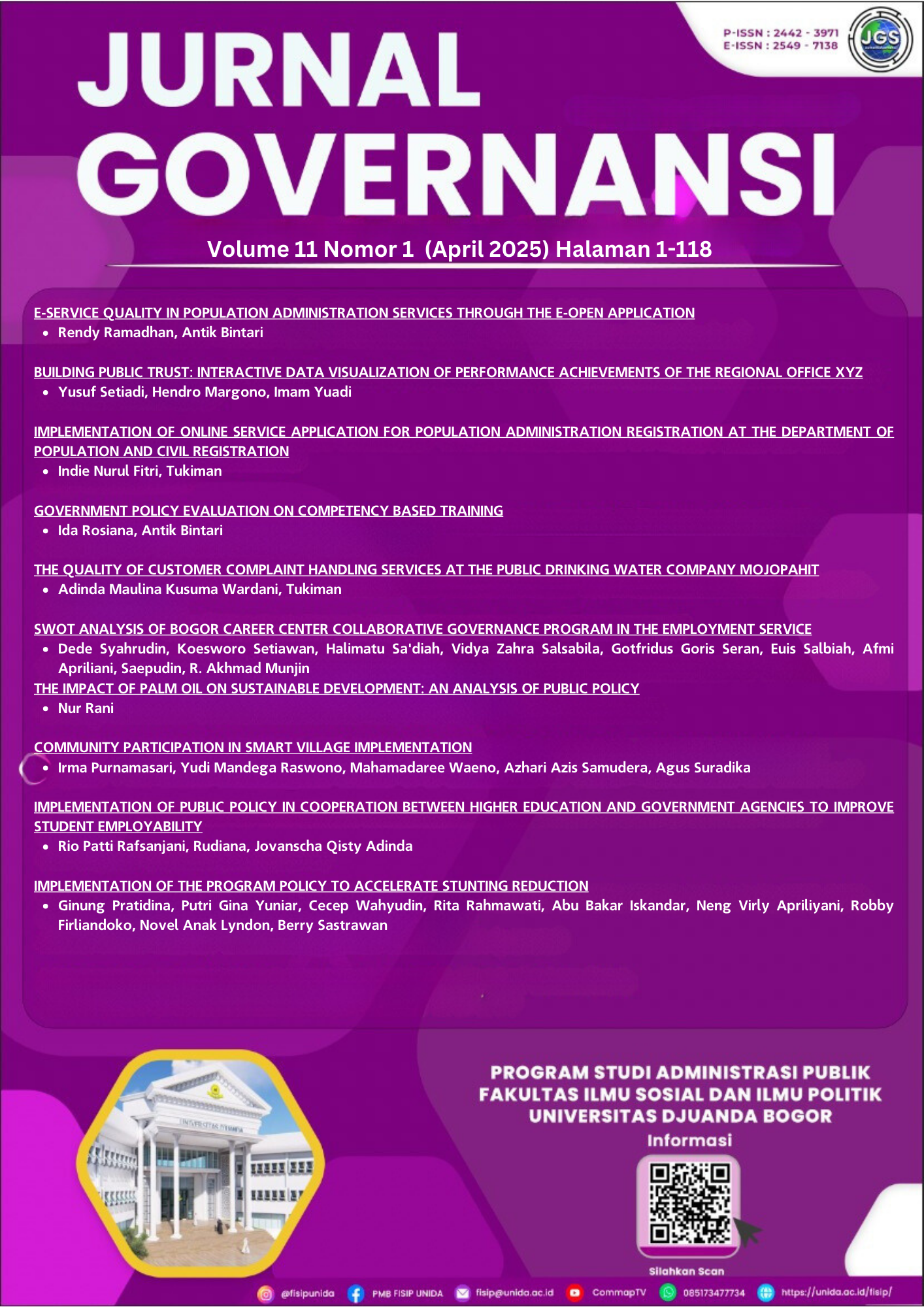
Unduhan
Diterbitkan
Cara Mengutip
Terbitan
Bagian
Lisensi
Hak Cipta (c) 2025 Irma Purnamasari, Yudi Mandega Raswono, Mahamadaree Waeno, Azhari Azis Samudera, Agus Suradika

Artikel ini berlisensiCreative Commons Attribution-ShareAlike 4.0 International License.
Authors who publish with Jurnal Governansi agree to the following terms:
- Authors retain copyright and grant the journal right of first publication with the work simultaneously licensed under a Creative Commons Attribution 4.0 International License that allows others to share the work with an acknowledgement of the work's authorship and initial publication in Jurnal Governansi.
- Authors are able to enter into separate, additional contractual arrangements for the non-exclusive distribution of the journal's published version of the work (e.g., post it to an institutional repository or publish it in a book), with an acknowledgement of its initial publication in Jurnal Governansi.
- Authors are permitted and encouraged to post their work online (e.g., in institutional repositories or on their website) prior to and during the submission process, as it can lead to productive exchanges, as well as earlier and greater citation of published work.