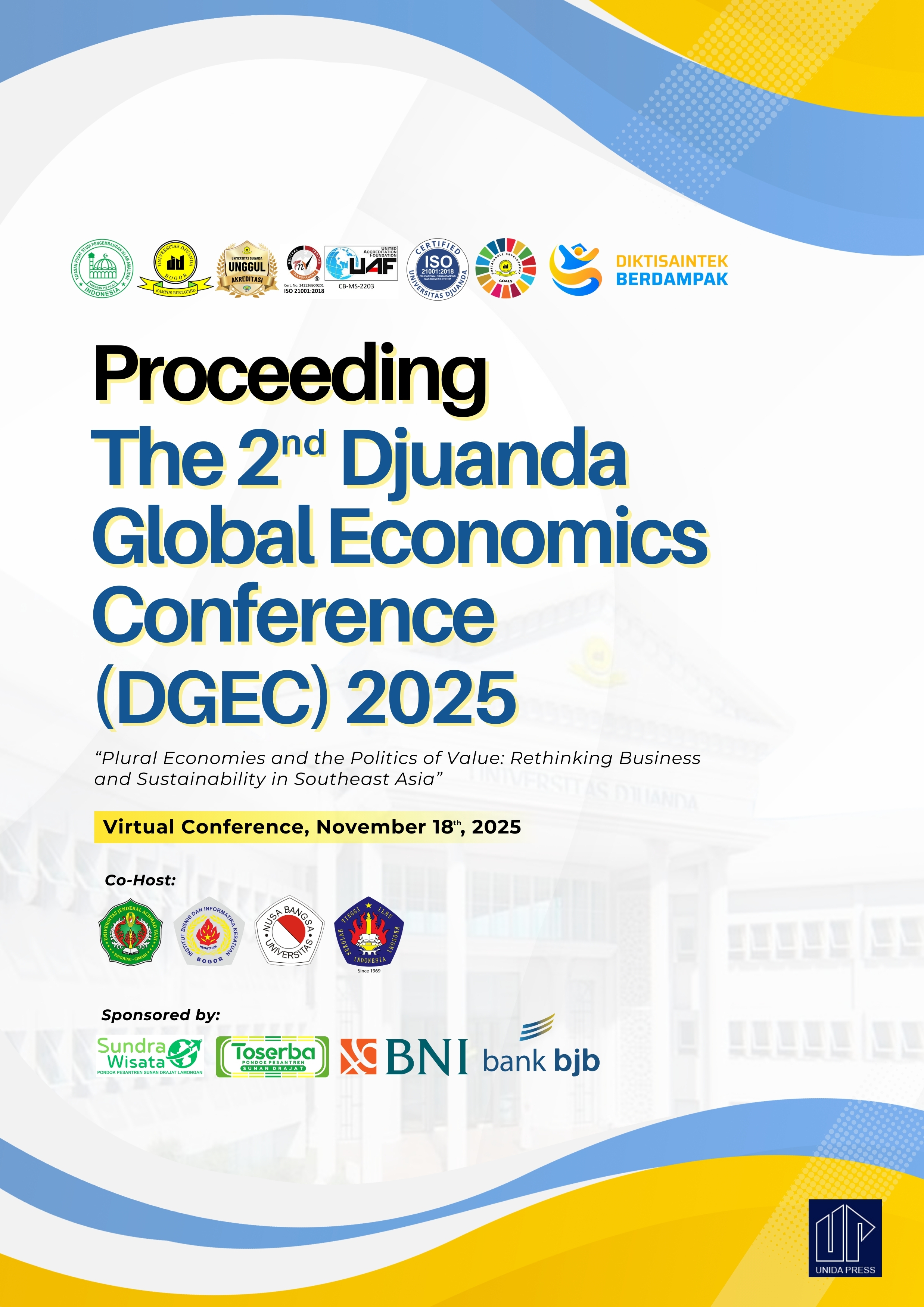
PLURAL ECONOMIES AND THE POLITICS OF VALUES: REIMAGINING SUSTAINABLE BUSINESS IN SOUTHEAST ASIA
Keywords:
Keywords: plural economies, politics of value, sustainable business, Southeast Asia, inclusive development.Abstract
Background: Southeast Asia represents a region of profound economic diversity, where formal, informal, communal, and digital systems coexist and interact in processes of production, distribution, and consumption. This multiplicity of systems generates a complex landscape in which the politics of value— the contestation over what is considered valuable or sustainable—plays a central role in shaping regional development trajectories. Understanding how these different economies interact is essential for addressing the challenges of building inclusive and sustainable growth across the region.
Purpose: The primary purpose of this study is to examine how businesses, governments, and local communities in Southeast Asia negotiate economic, social, and environmental values in constructing inclusive and sustainable business practices. It seeks to rethink the prevailing framework of sustainable business by exploring how plural economic systems and diverse value perspectives influence the regional definitions of sustainability and success. By situating sustainability within the plural economic realities of Southeast Asia, this study aims to provide an alternative lens for understanding inclusive development.
Methodology: Methodologically, this research adopts a qualitative and conceptual analytical approach to explore the interaction between multiple economic systems and their underlying value dynamics. It draws upon case- based insights, policy analyses, and theoretical discussions to understand how plural economies shape sustainable business practices across different local contexts. The study emphasizes interpretive and contextual analysis rather than quantitative measurement, aiming to capture the nuanced processes of value negotiation among varied stakeholders.
Finding: The findings reveal that the success of sustainable business in Southeast Asia is not determined solely by technological innovation or policy frameworks. Instead, it relies heavily on the capacity of diverse actors—businesses, governments, and local communities—to construct shared understandings of value and sustainability. Plural economies provide a foundation for integrating broader perspectives, enabling the emergence of adaptive, equitable, and contextually grounded business models that effectively respond to regional challenges.
Limitation: The main limitation of this study lies in its conceptual orientation, as it does not include extensive empirical or comparative case data. Future research incorporating fieldwork and cross-country analysis would strengthen the understanding of how plural economies function in practice to influence sustainable business outcomes across varying social and institutional contexts.
Originality: This research contributes original insights by linking the concept of plural economies with the politics of value to reinterpret sustainable business practices in Southeast Asia. Departing from conventional sustainability studies that emphasize technology or policy instruments, this study highlights the social and cultural dimensions of value creation as essential foundations for sustainable and inclusive economic transformation in the region.
Downloads
Published
Issue
Section
License
Copyright (c) 2025 Djuanda Global Economics Conference (DGEC)

This work is licensed under a Creative Commons Attribution-ShareAlike 4.0 International License.